
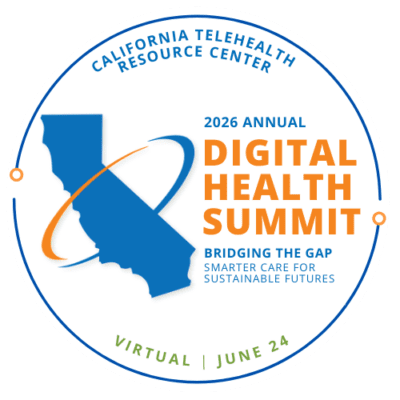
The California Telehealth Resource Center (CTRC) hosted its 14th Annual Digital Health Summit as a no-cost, virtual event bringing together healthcareleaders, clinicians, and operational teams from across the country.
The summit focused on how digital health and artificial intelligence are being used today to expand access, reduce administrative burden, and support sustainable care delivery, particularly for chronic conditions such as diabetes, cardiovascular disease, and obesity. Across sessions, speakers shared practical strategies, real-world implementation insights, and policy considerations shaping the future of care, including in rural and underserved communities.
From system-level strategy to frontline workflows, the event highlighted how healthcare organizations are using technology in ways that strengthen teams, improve patient reach, and support long-term sustainability.
SUMMIT SESSIONS AND RESOURCES
OPENING REMARKS
Setting the Vision: Digital Health, AI, and the Future of a Sustainable Health Ecosystem
Jennifer Stoll
The summit opened with a systems-level perspective on digital health and AI as part of a broader transformation in care delivery. The session emphasized how organizations can prioritize initiatives that reduce friction, support workforce capacity, and align technology with long-term sustainability goals.
OPENING KEYNOTE
Setting the Foundation: Statewide Digital Health Priorities under California’s Rural Health Transformation Program
Jacob Parkinson
The opening keynote outlined California’s approach to strengthening rural healthcare through the California Rural Health Transformation Program (CalRHT). The session highlighted how telehealth, remote patient monitoring, and workforce development are positioned as essential infrastructure to expand access and support regional models of care.
SESSION 1
From Clinic to Community: Scaling Chronic Disease Management Beyond the Visit
Yimdriuska Magan, MD, MPH
This session explored how care teams are extending chronic disease management beyond the exam room using telehealth, remote monitoring, and AI-enabled workflows. Speakers shared practical approaches to integrating digital tools into care delivery while balancing automation and human connection to improve patient engagement and outcomes.
SESSION 2
From Innovation to Sustainability: Payment and Policy Pathways That Make Digital Care Scalable
Chris Adamec, MPA; Rebecca Gwilt, Esq.
This session provided a national perspective on how evolving federal policy and Medicare payment pathways are shaping the future of digital health. Speakers examined key trends in telehealth, RPM/RTM, and value-based care, helping organizations understand what is becoming sustainable and how to design programs that can scale beyond pilot funding.
SESSION 3
Trust Is Built, Not Bought: Making AI Safe and Defensible in Clinical Care
Lydia M. Kotowski, JD, MHA; Sylvia Trujillo, MPP, JD
This discussion focused on how healthcare organizations can build trust in AI through strong governance, oversight, and alignment with existing clinical and regulatory frameworks. The session translated policy and compliance expectations into practical steps for implementing AI in a way that is safe, auditable, and scalable.
SESSION 4
Building What Lasts: Rural Digital Health Sustainability in Practice
Lily Lau, PhD; Martin Entwistle, MBA, MB, ChB, FRCSEd
In this session, rural healthcare leaders shared real-world experiences designing and implementing digital health strategies. The conversation highlighted lessons learned around workforce readiness, partnerships, and developing sustainable, network-based approaches to care delivery.
SESSION 5
Clinical AI That Delivers: Evidence, Workflow Fit, and What Actually Changes Care
David Wu, MD, PhD; Adam Rodman, MD, MPH, FACP
This session examined why some AI tools improve clinical care while others fall short. Speakers explored the importance of workflow integration, clinician trust, and ongoing evaluation, offering practical guidance for selecting and implementing AI solutions that support clinical decision-making.
CLOSING KEYNOTE
From Promise to Practice: Preparing Care Teams for Generative AI in the Next Year
Jonathan H. Chen, MD, PhD
The summit concluded with a forward-looking session on generative AI in healthcare. The keynote focused on near-term adoption, emphasizing workforce readiness, workflow design, and governance as critical factors in moving from early experimentation to safe and sustainable use.
CTRC 2026 DIGITAL HEALTH SUMMIT FAQs
SUMMIT BY THE NUMBERS
The 2026 CTRC Digital Health Summit brought together healthcare leaders, clinicians, administrators, policymakers, and innovators from across the country to explore practical approaches to digital health and artificial intelligence.
- 667 attendees participated in the summit
- 1,312 session registrations were recorded across the event
- 90% of attendees reported gaining information or insights they can apply in their work or organization
- 92% of attendees reported feeling confident in their ability to explain how digital health tools, including AI and telehealth, can optimize care delivery, workflows, and patient access within their organizations
These results reflect the growing demand for practical, evidence-informed guidance on implementing digital health strategies that support patients, care teams, and healthcare organizations.



Leave a Comment